Sunday, November 26, 2023

Supreme Court Strikes Blow for Deciding Cases and Explains What Is Jurisdictional and What Is Not

Author's Note: I started writing this post in April. My life has been a bit busy this year so I haven't blogged as much as in prior years. If you are already familiar with the holding of Moac Mall Holdings, you may want to skip to the end to the What It Means section.

In Justice Ketanji Brown Jackson's first major opinion, the Supreme Court ruled that 11 U.S.C. Sec. 363(m) is not a jurisdictional bar and batted away an appellate mootness argument. The ruling means that Mall of the Americas may continue to challenge the assignment of a lease to a subsidiary of a purchaser in the Sears bankruptcy case. However, in a larger sense, the opinion is a challenge to the rulings that have shielded many bankruptcy court rulings from appellate review. The case is No. 21-1270, MOAC Mall Holdings, LLC v. Transform Holdco, LLC, 508 U.S. ___ (U.S. 4/19/23). You can find the opinion here

What Happened

When Sears filed bankruptcy, it sold most of its assets to Transform Holdco, LLC. One of the assets it purchased was the right to designate who leases would be assumed and assigned to. It formed a subsidiary to assume a lease at Mall of the Americas. Mall of the Americas objected that Transform Holdco could not prove that its newly formed entity could not provide adequate assurance of future performance under 11 U.S.C. Sec. 365(f)(2)(B). The Bankruptcy Court overruled the objection. MOAC requested a stay pending appeal. The Bankruptcy Court denied the stay on the basis that Sec. 363(m) did not apply. Transform insisted that it would not rely on Sec. 363(m).

MOAC appealed to the District Court which reversed the order approving the assignment. Transform then moved for reconsideration on the basis that Sec. 363(m) deprived the Court of jurisdiction to hear the appeal (the very position it had told the Bankruptcy Court it would not assert). The District Court was not happy and said some choice things about Transform. Nevertheless, it held that it lacked jurisdiction and dismissed the appeal. MOAC appealed to the Second Circuit which affirmed in an unpublished order.

The Issue at the Supreme Court 

Section 363(m) states that:

The reversal or modification on appeal of an authorization under [§363(b) or §363(c)] of a sale or lease of property does not affect the validity of a sale or lease under such authorization to an entity that purchased or leased such property in good faith, whether or not such entity knew of the pendency of the appeal, unless such authorization and such sale or lease were stayed pending appeal.

The Second Circuit had previously held that Sec. 363(m) was jurisdictional, meaning that an appellate court had no power to review an order falling within its power while the Third and Eleventh Circuits said that it was not. Justice Jackson framed the issue this way:

In this case, we are called upon to decide whether §363(m)’s strictures are jurisdictional. If so, a party may invoke that provision at any time—without fear of waiver, forfeiture, or similar doctrines interposing. If not, courts can apply such doctrines when evaluating §363(m) issues, where appropriate. 

Opinion, p. 2. 

It's Not Jurisdictional

Justice Jackson and the unanimous Court concluded that Sec. 363(m) was not jurisdictional. 

Congressional statutes are replete with directions to litigants that serve as “preconditions to relief.” Filing deadlines are classic examples. So are preconditions to suit, like exhaustion requirements.  So, too, are “statutory limitation[s] on coverage,” or“on a statute’s scope,” such as the “element[s] of a plaintiff ’s claim for relief.” Congress can, if it chooses, make compliance with such rules “important and mandatory.” But knowing that much does not, in itself, make such rules jurisdictional.

The “jurisdictional” label is significant because it carries with it unique and sometimes severe consequences. An unmet jurisdictional precondition deprives courts of power to hear the case, thus requiring immediate dismissal. And jurisdictional rules are impervious to excuses like waiver or forfeiture. Courts must also raise and enforce them sua sponte.

This case exemplifies why the distinction between nonjurisdictional and jurisdictional preconditions matters. In light of Transform’s belated invocation of §363(m), the District Court stated that, “if ever there were an appropriate situation for the application of judicial estoppel, this would be it.”  But not even such egregious conduct by a litigant could permit the application of judicial estoppel as against a jurisdictional rule. 

In view of these consequences and our past sometimes-loose use of the word “jurisdiction,” we have endeavored “to bring some discipline” to this area.  We have clarified that jurisdictional rules pertain to “ ‘ “the power of the court rather than to the rights or obligations of the parties.” ’ ” And we only treat a provision as jurisdictional if Congress “ ‘clearly states’ ” as much. 

This clear-statement rule implements “Congress’ likely intent” regarding whether noncompliance with a precondition “governs a court’s adjudicatory capacity.”  We have reasoned that Congress ordinarily enacts preconditions to facilitate the fair and orderly disposition of litigation and would not heedlessly give those same rules an unusual character that threatens to upend that orderly progress.

Opinion, pp. 7-8 (cleaned up). To sum up, jurisdictional limitations are limitations on the power of the court, not the parties and Congress must clearly state when it is imposing a jurisdictional limit. First, there must be an express jurisdictional grant, such as diversity jurisdiction or bankruptcy jurisdiction under 28 U.S.C. Sec. 1334 or appellate jurisdiction under 28 U.S.C. Sec. 1291. If there is not an affirmative grant of jurisdiction, the court has no power to proceed. However, even if there is an affirmative grant of jurisdiction, there may be cases in which Congress has taken that jurisdiction away. Transform was arguing that Sec. 363(m) fell into this second category, that it took the power to adjudicate certain disputes regarding sales or leases away from the appellate courts if a stay pending appeal was not granted. 

Supremes Say No to Equitable Mootness

In keeping with the focus on deciding cases on the merits, the Court also rejected an equitable mootness argument. This was not a hard call. None of the lower courts applied equitable mootness. As a result, there was not a factual record for the court to rule on. To apply equitable mootness at the Supreme Court level, the Court would have to find that application of the doctrine was required under the undisputed facts of the case. Justice Brown dispatched this argument as easily as she rejected the jurisdictional argument. (Note: The Court's opinion addressed mootness first. Because it was a secondary issue to me, I addressed it in order of importance). 

Justice Brown explained equitable mootness using these words:

A “case becomes moot only when it is impossible for a court to grant any effectual relief whatever to the prevailing party.”  The case remains live “‘[a]s long as the parties have a concrete interest, however small, in the outcome of the litigation.’” 

Opinion, p. 5. Justice Brown noted that mootness is disfavored, which must have come as a surprise to all of the hundreds of courts that have used it as a means to clear their dockets. In the end, she found that that the Supreme Court was not going to not going to act as a court of first review where it was not clear that no relief could be granted. She wrote:

Here, as elsewhere, we decline to act as a court of “‘first view,’” plumbing the Code’s complex depths in “‘the first instance’” to assure ourselves that Transform is correct about its contention that no relief remains legally available.

Opinion, p. 6. Under this formulation, mootness is a doctrine of last resort. For example, if a criminal defendant passes away while a case is on appeal, the correctness of the sentence becomes moot since the defendant has already been granted release. 

The Post-Script 

On November 6, 2023, the Second Circuit vacated the decision of the District Court and remanded the case for further proceedings. MOAC Mall Holdings, LLC v. Transform Holdco (In re Sears), 2023 U.S. App. LEXIS 29477 (2nd Cir. 2023). It found that because Sec. 363(m) was not jurisdictional, the District Court should not have dismissed the appeal. 


Wednesday, October 18, 2023

NCBJ 2023: The Valuation Paradox

In the program Who Killed the Company? Tips and Trends in Claims and Defenses, Judge Marvin Isgur and his fellow panelists confronted issues such as in pari delicto, insurance coverage and waiver of fiduciary duties. However, one discussion led by Judge Isgur focused on whether solvency should be determined based on what was known at the time of the valuation or what was known at a later date. The discussion highlighted that valuation can be a moving target based on what is known at a given point in time. 

Sunday, October 15, 2023

NCBJ 2023: The View from Austin

 The National Conference of Bankruptcy Judges came to Austin for its 2023 conference with the slogan Blues, Barbecue and Bankruptcy. Here are some images from the conference.


Sheriff Ronnie King was the Master of Ceremonies for the Conference.


Chief Judge Craig Gargotta welcomed conference goers to Austin.


The Western District delegation


Judge Shad Robinson


Judge Ronnie King

Law Clerk Bach Norwood


                  The Rockestra


                    That's a lot of bull


                      Ouch


Tuesday, February 28, 2023

The Bankruptcy Judges of the Western District of Texas

The Western District of Texas crosses two time zones, has a population of 7.6 million and contains 93,000 square miles.  It is larger than the State of Oklahoma but smaller than the State of New Mexico. It contains the 7th, 11th and 24th largest cities in the United States (San Antonio, Austin and El Paso respectively). Since the Bankruptcy Code was adopted, the Western District has been served by 12 judges.  The judges of the Western District have come from San Antonio, Houston, Waco and El Paso. I have appeared in front of ten of them.

Thursday, February 23, 2023

Grammar Dooms Innocent Spouse in Non-Dischargeability Case

While we often recite that bankruptcy is for the honest but unfortunate debtor, a new case from the Supreme Court shows that getting into bed or business with the wrong person can lead to a non-dischargeable debt for an innocent spouse. The case is No. 21-908, Bartenwerfer v. Buckley, which you can find here.

Thursday, December 22, 2022

Notes on a Diversity Workshop

 At the ABI Winter Leadership Conference, I attended a diversity and inclusion workshop put on by Elton Ndoma-Ogar of Alix Partners and Peter S. Salib of Perkins Coie, LLP. I wasn't sure that writing about an interactive workshop would be useful, but a friend encouraged me to try. At the end of the article, I have included a link to their materials, which you can access if you are an ABI member. If you are not an ABI member, contact me and I can send them to you.

Friday, December 16, 2022

NCBJ 2022: Gradually, Then Suddenly. The Bankruptcy of Detroit

This program looked at the bankruptcy of the City of Detroit through the lens of a documentary filmmaker. I thought it was a clever way to look at one of the most consequential bankruptcies of our time through the eyes of someone who was not a bankruptcy lawyer or judge. While filmmaker Sam Katz is not part of the bankruptcy profession, he did have substantial experience in municipal finance, having served as Chair of the Fiscal Oversight Board in Philadelphia in the 1990s. It took him six years to make the film compared to the fourteen months that Detroit was in bankruptcy. I have included a link to a website about the film at the end.

Saturday, December 10, 2022

NCBJ 2022: The Role of the Bankruptcy Judge


 This panel asked the question, what is the role of the bankruptcy judge? To answer that question, they featured two retired judges, Judge Robert Drain from the Southern District of New York and Judge Harlan "Cooter" Hale from the Northern District of Texas along with sitting judges Erithe Smith from the Central District of California and Grace Robson from the Middle District of Florida. Rather than trying to recreate their panel, I will try to distill their presentation into a series of rules.

Friday, December 02, 2022

Counsel's Retention of "Wet Signatures" Overcomes Debtor's "Faulty" Memory

Sometimes debtors get buyer's regret after filing a bankruptcy petition.  However, once a bankruptcy petition is filed, it remains on the debtor's credit for ten years. One debtor sought to throw his attorney under the bus by claiming that the bankruptcy filing had never been authorized. Fortunately the debtor's attorney had retained his client's wet signatures and text messages which protected him from the Court's Order to Show Cause. In re Wilson, 2022 Bankr. LEXIS 3378 (Bankr. D. N.J. 11/30/22).  

Monday, November 28, 2022

Judge Gargotta Nixes Non-Dischargeability Claim Against Corporate SubV Debtor

 Distinguishing a precedent from his own district and disagreeing with the Fourth Circuit, Judge Craig Gargotta has ruled that non-dischargeability only applies to human Subchapter V debtors. Adv. No. 22-5052, Avion Funding, LLC v. GFS Industries, LLC (Bankr. W.D. Tex. 11/10/2022).  The decision can be found here. The decision was especially sweet for me personally because the case it distinguished, New Venture Partnership v. JRB Consolidated, Inc. (In re JRB Consolidated, Inc.), 188 B.R. 373, 374 (Bankr. W.D. Tex. 1995), was one that I lost and always thought was wrongly decided. 

Sunday, November 13, 2022

NCBJ 2022: The Devastating Impact of the Opioid Crisis featuring Pulitzer Prize Winning Journalist Eric Eyre


 "The opioid crisis is nothing short of sinister."

Eric Eyre and Patrick McGinley from the West Virginia University College of Law, told the story of how a small town journalist discovered the cause of the opioid epidemic in Appalachia. Along the way, Mr. Eyre developed Parkinson's disease, won the Pulitzer Prize for his book and had his newspaper file for Chapter 11 relief. Prof. McGinley represented the newspaper pro bono in making open records act requests which were repeatedly rebuffed.  

Monday, November 07, 2022

NCBJ 2022: Mass Torts in Bankruptcy: Two Steps Forward or Two Steps Back


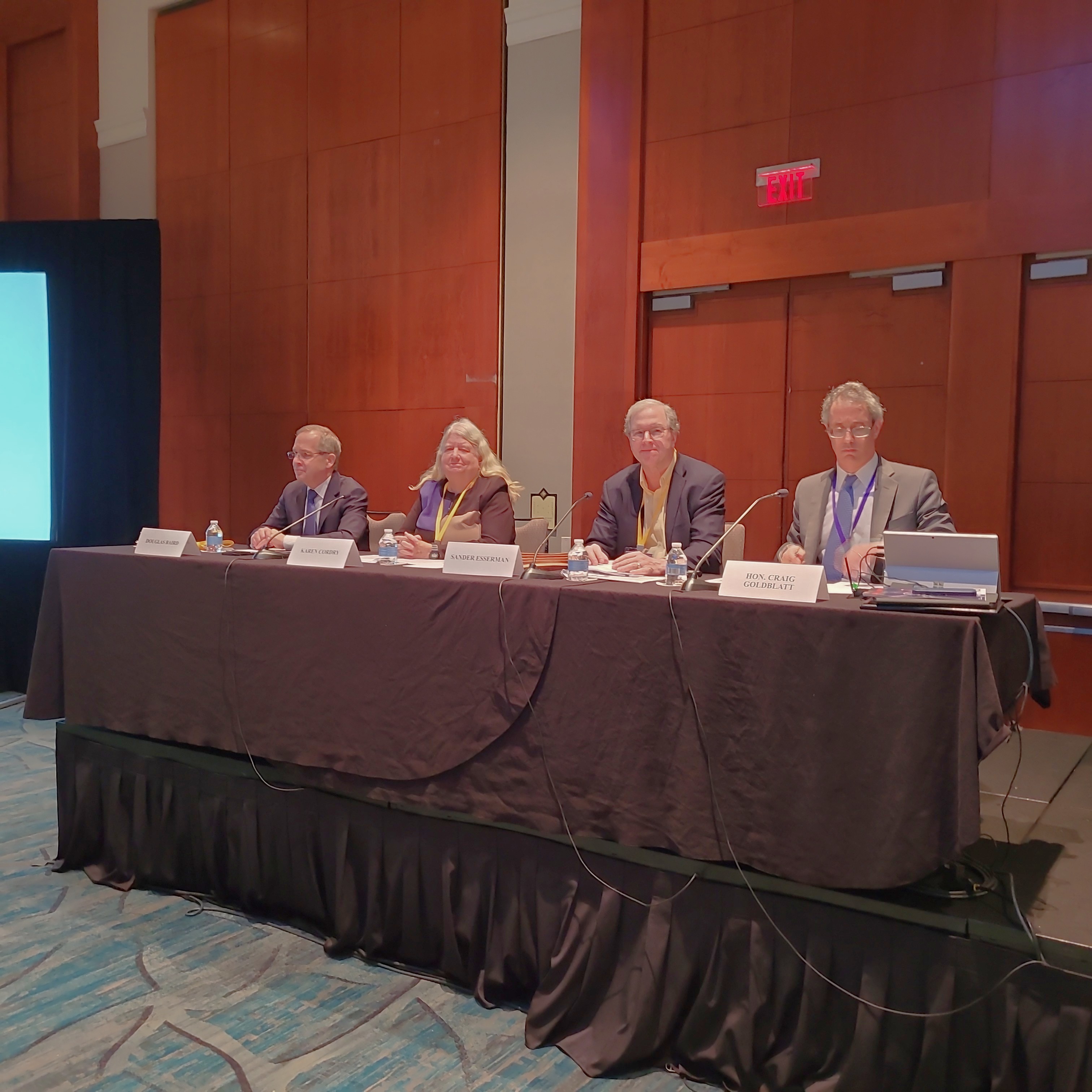
One of the big themes appearing in this year's National Conference of Bankruptcy Judges was the effect of mass tort cases on the bankruptcy system. The panel Mass Torts in Bankruptcy: Two Steps Forward or Two Steps Back focused on third party releases. The speakers were Hon. Craig Goldblatt (Bankr. D. Del.), Karen Cordry from the National Association of Attorneys' General, Prof. Douglas Baird and Sander Esserman.  

Third party releases have been in the news a lot lately. In Purdue Pharma and Mahwah Bergen Retail Group, District Courts struck down overly broad provisions, while they were allowed in the Mallinckrodt PLC case. 

Monday, October 31, 2022

NCBJ 2022: Bankruptcy Boom or Bust - How Far Is Too Far and Is the Day of Reckoning Here?


The first plenary session of NCBJ was a panel consisting of Professor Melissa Jacoby, Jennifer Hagle from Sidley and Austin and Judge Lisa Beckerman (Bankr. S.D.N.Y.). My overall impression of the panel was that it consisted of Prof. Jacoby asking why parties in big bankruptcy cases should be allowed to bend the rules, Ms. Hagle saying that its necessary to meet the demands of her creditor clients and Judge Beckerman trying to make sense of what parties are telling her. The Moderator, Judge Elaine Hammond, brought in the views of some of her judicial colleagues in the audience.

Thursday, October 27, 2022

NCBJ 2022: Post-Pandemic Ethics

Besides sweeping away the competition in ballroom dancing competitions and having been a law school dean at a young age, Prof. Nancy Rapoport is known as the teacher who can make ethics interesting.  She gave the keynote address for the Commercial Law League luncheon titled Brave New World--Ethics Issues That We Never Knew We Had. 

Monday, October 24, 2022

NCBJ 2022: Five Secrets to a Magical Sub-V

Judge Catherine McEwen (Bankr. M.D. Fla.) and panelists David Mawhinney (Bowditch, Framingham, Mass.), Amy Denton Mayer (Stichter Riedel Blain Postler, PA, Tampa, Fl) and Kirk Burkley (Bernstein-Burkley, P.C., Pittsburgh, PA) donned their wizard's hats to present 5 Secrets to a Magical Sub-V. Both David and Amy serve as Subchapter V trustees and represent SubV debtors, while Kirk offered the creditors' viewpoint. Their program covered five areas of Subchapter V law and practice.

Sunday, October 23, 2022

NCBJ 2022: Awards Edition

Every year numerous awards are presented at the National Conference of Bankruptcy Judges. These awards are an opportunity to recognize people who have contributed to the insolvency profession.

Saturday, October 22, 2022

NCBJ 2022: What's Hot

When the nation's bankruptcy judges, academics and practitioners get together for the National Conference of Bankruptcy Judges, there are certain topics that tend to dominate. This year mass torts were a through line in many of the presentations.  A presentation on pushing the boundaries of chapter 11 suggested that mass tort cases did not have the same urgency as melting ice cube operating businesses. A panel on third party releases noted the difference between the use of third party releases to protect guarantors as opposed to those developed in mass tort cases. ABI Editor at Large Bill Rochelle has nightmares about Congress seeing abuses in mass tort cases and passing legislation without the input of bankruptcy experts. His panel also delved deeply into the Texas Two-Step.  There was even a presentation by a Pulitzer Award winning journalist and the law professor who helped him crack the source of the opioid epidemic.  As I write up my articles from this year's conference, there will be many references to issues raised by mass tort cases.

Sunday, October 16, 2022

Fifth Circuit Opinion on Solvent Debtor Illustrates Tension Between Text and Tradition

Bankruptcy opinions tend to rely on two major tools for interpreting the Bankruptcy Code: the statutory text and pre-Bankruptcy Code practice. These two methods came into conflict in the Fifth Circuit's recent opinion in Ultra Petroleum Corp. v. Ad Hoc Committee (In re Ultra Petroleum), No. 21-20008 (5th Cir. 10/14/2022), which can be found here.   The majority relied on pre-Code practice to allow creditors of a solvent debtor to recover their full contractual interest. 

Sunday, October 02, 2022

Fifth Circuit Holds Line on Exculpation Clauses But Offers Some Help

The Fifth Circuit is largely resistant to third party release provisions. The Circuit will enforce a clearly defined third-party release that is not objected to, Republic Supply Co. v. Shoaf, 815 F.2d 1046 (5th Cir. 1987), but will not sustain such a provision if a timely objection is filed, Ad Hoc Group of Vitro Noteholders v. Vitro SAB De CV (In re Vitro SAB De CV), 701 F.3d 1031 (5th Cir. 2012). It is also resistant to bar orders, Feld v. Zale Corp., (In re Zale Corp). 62 F.3d 746 (5th Cir. 1995) and most exculpation clauses, Bank of New York Trust Co., NA v. Official Unsecured Creditors' Comm. (In re Pacific Lumber Co.), 584 F.3d 229 (5th Cir. 2009).   (If you need more background on these different types of third-party releases, I would be happy to provide you with my paper from the last Western District Bench-Bar Conference which discusses these issues at length).  

The Court recently rebuffed an attempt to distinguish its jurisprudence on exculpation clauses but offered other limited relief.  The case is Nexpoint Advisors, L.P. v. Highland Capital Mgmt., L.P. (In re Highland CapitalMgmt., L.P.), 2022 U.S. App. LEXIS 25107 (5th Cir. 9/7/22). 

What Happened

This is the story of a billion-dollar investment fund and its break-up with one of its founders. Highland Capital Management, LP was a Dallas-based investment fund co-founded by James Dondero. In 2019, Highland filed bankruptcy in the U.S. Bankruptcy Court for the District of Delaware. The case was transferred to the Northern District of Texas.

The Fifth Circuit noted that the case “did not proceed under the governance of a traditional chapter 11 trustee.” Of course, having a chapter 11 trustee is the exception rather than the rule. What the court meant was that the parties fashioned a bespoke remedy for control of the Debtor.  Dondero stepped down as control person of the Debtor’s general partner and was replaced by three independent directors approved by the court, including a former bankruptcy judge. The Court barred any claims against the independent directors without prior court approval. The Court subsequently appointed a Chief Restructuring Officer. Thus, the parties obtained a de facto trustee of their own choosing. 

Dondero proposed several plans which were not confirmed. The Committee and the Independent Directors negotiated their own plan. When Dondero couldn’t get his plans confirmed, “he and other creditors began to frustrate the proceedings by objecting to settlements, appealing orders, seeking writs of mandamus, interfering with Highland Capital's management, threatening employees, and canceling trades between Highland Capital and its clients.” Eventually the Bankruptcy Court held him in civil contempt and fined him $100,000.  Dondero and the U.S. Trustee objected to the plan’s exculpation provisions.

The Bankruptcy Court confirmed the Plan and appeals followed. The Fifth Circuit generally affirmed the plan but pared back the exculpation clauses.

Exculpation

Exculpation clauses are a subspecies of third-party releases. They preclude any party from suing various parties associated with the plan except for gross negligence or willful misconduct. Their practical effect is to bar claims for ordinary negligence in connection with the plan process.

Exculpation clauses have both a proper use and an improper one. The improper use is to shield professionals from their own negligence. The proper use is to encourage parties to work together to confirm consensual plans safe in the knowledge that they won’t get sued if things don’t work out. A third reason to include an exculpation clause is that it’s part of an attorneys’ boilerplate and no particular thought went into including the clause.

The plan in this case had two provisions which protected the plan participants:  the exculpation clause and the gatekeeper clause. The parties protected included the Debtor, its employees, the Chief Restructuring Officer, the independent directors, the Unsecured Creditors’ Committee, the professionals and the "Related Parties.” 

According to the Fifth Circuit:

The Plan exculpates the protected parties from claims based on any conduct "in connection with or arising out of" (1) the filing and administration of the case, (2) the negotiation and solicitation of votes preceding the Plan, (3) the consummation, implementation, and funding of the Plan, (4) the offer, issuance, and distribution of securities under the Plan before or after the filing of the bankruptcy, and (5) any related negotiations, transactions, and documentation. But it excludes "acts or omissions that constitute bad faith, fraud, gross negligence, criminal misconduct, or willful misconduct" and actions by Strand and its employees predating the appointment of the Independent Directors.

The Fifth Circuit also explained the gatekeeper clause as follows:

Under the Plan, bankruptcy participants are enjoined "from taking any actions to interfere with the implementation or consummation of the Plan" or filing any claim related to the Plan or proceeding. Should a party seek to bring a claim against any of the protected parties, it must go to the bankruptcy court to "first determin[e], after notice and a hearing, that such claim or cause of action represents a colorable claim of any kind." Only then may the bankruptcy court "specifically authoriz[e]" the party to bring the claim. The Plan reserves for the bankruptcy court the "sole and exclusive jurisdiction to determine whether a claim or cause of action is colorable" and then to adjudicate the claim if the court has jurisdiction over the merits.

The Court’s Ruling

The Court upheld the exculpation clause as to the Debtor, the Unsecured Creditors’ Committee and the independent directors. Under Pacific Lumber, a release may only be approved if provided elsewhere in the Code. The Debtor receives a release because it is discharged under the Plan. The Court in Pacific Lumber found that the Code provisions relating to members of the Unsecured Creditors’ Committee allowed their exculpation.

The Court found that the independent directors were entitled to exculpation because they were acting in the role of a trustee. The Court stated that:

That leaves one remaining question: whether the bankruptcy court can exculpate the Independent Directors under Pacific Lumber. We answer in the affirmative. As the bankruptcy court's governance order clarified, nontraditional as it may be, the Independent Directors were appointed to act together as the bankruptcy trustee for Highland Capital. Like a debtor-in-possession, the Independent Directors are entitled to all the rights and powers of a trustee. It follows that the Independent Directors are entitled to the limited qualified immunity for any actions short of gross negligence. Under this unique governance structure, the bankruptcy court legally exculpated the Independent Directors. (cleaned up).

Nevertheless, the Court found that outside of these three groups, exculpation was improper and had to be reversed. This applied primarily to the bankruptcy professionals, the CRO, the Debtor’s employees and the “Related Parties.”

However, the Court did not leave then un-exculpated parties without any protection. It upheld the gatekeeper provisions. The Court analogized the gatekeeper provisions to the Barton Doctrine which protects Trustees from being sued without prior court permission. The Court stated:

Courts have long recognized bankruptcy courts can perform a gatekeeping function. Under the "Barton doctrine," the bankruptcy court may require a party to "obtain leave of the bankruptcy court before initiating an action in district court when the action is against the trustee or other bankruptcy-court-appointed officer, for acts done in the actor's official capacity." In Villegas, we held "that a party must continue to file with the relevant bankruptcy court for permission to proceed with a claim against the trustee." Relevant here, we left to the bankruptcy court, faced with pre-approval of a claim, to determine whether it had subject matter jurisdiction over that claim in the first instance. In other words, we need not evaluate whether the bankruptcy court would have jurisdiction under every conceivable claim falling under the widest interpretation of the gatekeeper provision. We leave that to the bankruptcy court in the first instance. (cleaned up).

What Does It Mean?

The Fifth Circuit remains resistant to broad exercises of power untethered to the Code.  However, it is willing to consider pragmatic expansions of existing precedent. Here, the problem was that one party had proven himself to be unduly litigious. This meant that the plan proponents and related parties had a legitimate concern that they might be sued over the plan in a forum unfamiliar with the bankruptcy case. While the Barton Doctrine is an equitable doctrine specifically intended to protect trustees from being sued without permission, the Fifth Circuit was willing to endorse its extension to a broad class of plan-related parties. This partial measure protects the parties from frivolous suits without granting blanket releases.

This suggests that the Fifth Circuit would also consider other partial measures that stop short of outright releases. In particular, it seems likely that the Fifth Circuit would allow temporary injunctions against collection of debts from insiders during the period of plan performance as was done by Judge Barbara Houser in In re Seatco, 257 B.R. 469 (Bankr. N.D. Tex. 2001).

The message to plan drafters in the Fifth Circuit is that if you can’t get consensus, be modest, be practical, and find a hook in the Code or existing precedent.


Thursday, August 11, 2022

Chapter 11 Trustee Recovers Enhanced Lodestar for Superior Result

 Bankruptcy trustees often perform a thankless job, scrubbing through thousands of no-asset files looking for that one case that will earn them a sizeable commission. While Chapter 7 trustees are paid a commission on funds distributed to creditors, compensation for Chapter 11 trustees more closely resembles an hourly fee engagement. A recent case from Judge Tony Davis of the Western District of Texas illustrates how the two forms of compensation may dramatically differ. In re WC Met Center, LLC, Case No. 21-10698 (Bankr. W.D. Tex. 7/15/22). The opinion can be found here